
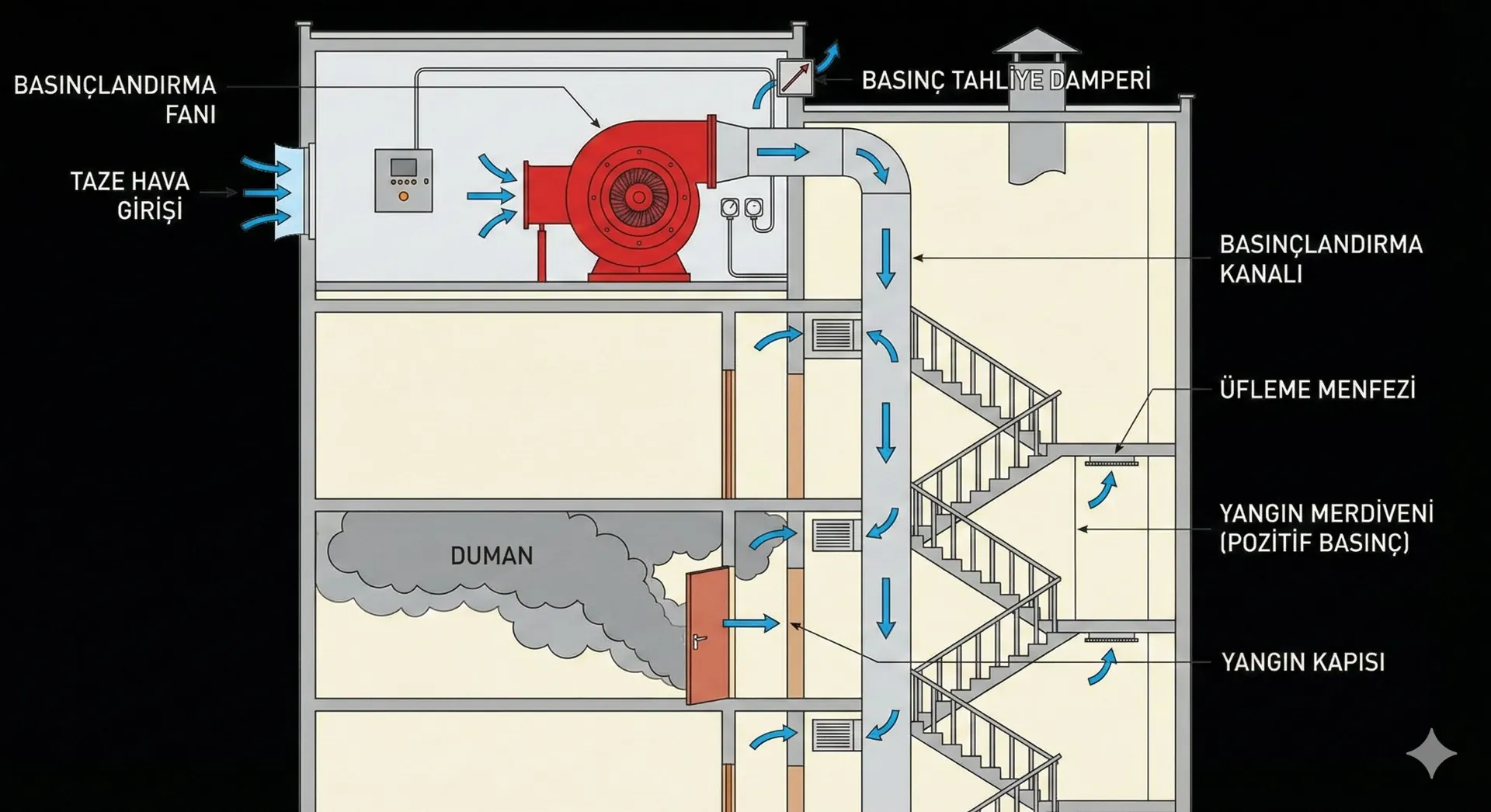
Escape route pressurization systems are vital safety installations that prevent smoke ingress by creating positive pressure in stairwells, elevator shafts, and fire lobbies during a fire. Periodic inspections of these systems are conducted in accordance with the Directive on Fire Protection Systems in Buildings, relevant standards, and legal requirements.
1. Periodic Inspection Criteria
The following technical and safety criteria are taken as a basis for the periodic inspections of pressurization systems:
- Design and Capacity Compliance: The system's capacity is verified against the project design for differential pressure requirements in "closed-door" scenarios and air velocity values in "open-door" scenarios.
- Mechanical Integrity: The physical condition of the fan housing, motor bearings, belt-pulley assemblies, air ducts, and intake louvers is evaluated for vibration, corrosion, and mounting stability.
- Sealing and Structural Condition: The sealing performance of pressurized shaft walls, door gaskets, and fire-stop sealants at cable/pipe penetration points is inspected.
- Safety and Relief Mechanisms: Over-pressure relief dampers and motor protection switches that ensure the safe operation of the system are rigorously tested.
- Electrical and Control Systems: The electrical panel, wiring, control buttons, and automation systems are inspected for functionality and safety.
- Safety and Limiting Systems: The operation of overload limiters, upper/lower limit switches, emergency stop systems, and warning mechanisms is verified.
- Marking and Documentation: The availability of system ID tags, emergency instructions, and maintenance records is evaluated.
2. Periodic Inspection Methods
Periodic inspection activities are conducted in an impartial, independent, and traceable manner using the following methods:
- Visual Inspection: The fan unit, ductwork, and vents are visually inspected to oversee the quality of installation and cleanliness.
- Functional Testing: Scenario testing is performed via the fire alarm system to verify the automatic activation time and response of the system.
- Measurement and Comparison: With all doors closed, the pressure difference between the pressurized zone and the common area is measured using a calibrated manometer.
- Door Opening Force Test: While the system is operating at full capacity, the force applied to the escape door handle is tested with a dynamometer to ensure it does not exceed regulatory limits (max. 110 N).
- Air Velocity Measurement: With the evacuation door open, the air velocity through the door cross-section (e.g., 0.75 m/s) is measured using an anemometer to verify the smoke-repelling capacity.
- Engineering Evaluation: All gathered data and measurement results are analyzed in line with engineering calculations and standard criteria to form a final compliance decision.
3. Reporting and Compliance Decision
The report prepared following the periodic inspection clearly includes the applied inspection methods, measurement results, regulatory and standard references, and the compliance status. The compliance decision is based solely on objective technical data and measurable criteria.
Conclusion: Periodic inspections of escape route pressurization systems are carried out using precise measurement techniques to ensure that escape routes remain smoke-free and to maintain a sustainable, safe evacuation environment.